Ch 1 | Ch 2 | Ch 3 | Ch 4 | Ch 5 | Ch 6
Ch 7 | Ch 8 | Ch 9 | Ch 10 | Ch 11
All-In-One | Adobe PDF Format
 
Next -> 
The Dark Side
of Sleeping Pills

 
By Daniel F. Kripke, M.D.*

Newly Revised:
February 2012
 

CHAPTER 1

SLEEPING PILLS COULD SHORTEN YOUR LIFE


1.A.New sleeping pills cause cancer in animals
 1.B. Evidence that sleeping pills cause cancer in people
 1.C.More lethal risks of sleeping pills

This little book explains mortality and cancer risks of sleeping pills, and which of today's popular sleeping pills should not be used. It also describes better alternatives.
Table of Contents


WARNING: Sleeping pills are hazardous to your health and could cause death from cancer, heart disease, or other illnesses.


For over 35 years I have worked to assess the risks of sleeping pills. I have learned that sleeping pills are associated with significantly increased mortality.


This means that people who take sleeping pills die sooner than people who do not use sleeping pills.


I first became interested when I saw the work of Dr. E. Cuyler Hammond at the American Cancer Society. In 1975, I went to visit The American Cancer Society, starting a collaboration which lasted for many years. American Cancer Society data from over 1 million people showed that use of sleeping pills was associated with more deaths within 6 years, but insomnia by itself was not associated with any death risk.

As of January, 2012, there were 24 published studies of the mortality risks of sleeping pills. Of the 22 studies which reported either greater or lesser mortality associated with sleeping pills, 21 studies showed that people taking sleeping pills died sooner. (The 22nd study found no mortality risk of sleeping pills but did find sleeping pill usage associated with increased cancer deaths.)

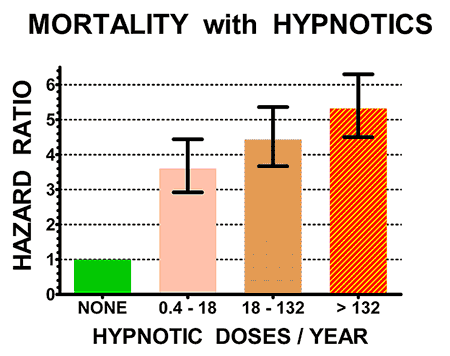
We have now published a new studyFootnote - click to read of over 10,000 patients who took sleeping pills and over 20,000 matched patients who did not take sleeping pills. The patients who took sleeping pills died 4.6 times as often during follow-ups averaging 2.5 years. Patients who took higher doses (averaging over 132 pills per year) died 5.3 times as often. Even those patients who took fewer than 18 pills per year had very significantly elevated mortality, 3.6 times that of patients who took no hypnotics.


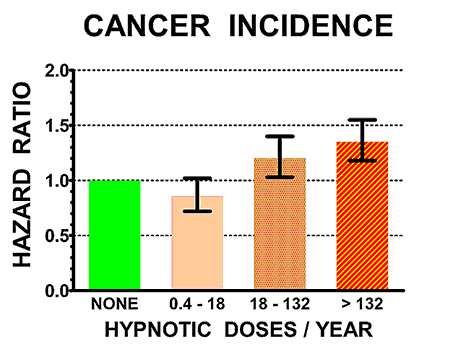
The figures above show the hazard ratios for mortality (above) and cancer incidence (below) for the control non-users of hypnotics (doses/year = NONE, in green) and for three groups of users of hypnotics with increasing numbers of doses/year prescribed. Hazard ratios above 1.0 are estimates of how many times the mortality or cancer incidence of hypnotics users exceeded that of controls. The heavy black bars show the statistical 95% confidence limits of the hazard estimates, that is, statistically the hazard ratio of the sample is 95% likely to be within the bars above and below the vertical black lines. However, unknown biases in the samples could produce true risks outside the confidence limits.


Patients who took sleeping pills died 4.6 times more often (on average) than patients who avoided sleeping pills.


It seems quite likely that the sleeping pills were causing early death for many of the patients. In addition, those who averaged over 132 sleeping pills per year were 35% more likely to develop a new cancer.

We went to great pains and effort to match the patients taking sleeping pills with those not taking sleeping pills for age, sex, smoking history, and various measures of poor health, so it seemed to be a fair comparison. Nevertheless, it is true that showing that sleeping pill use is associated with early death does not prove that the sleeping pills are causing the deaths. Theoretically, there could be confounding factors or biases in the selection of patients which caused these deaths without involving sleeping pills. We can only say that we found almost no evidence of such biases. Although there was certainly at least a small amount of confounding, it seemed to us unlikely that biases could entirely explain all of these excess deaths and cancers. If sleeping pills cause even a small portion of the excess deaths and cancers associated with their use, they are too dangerous to use.


If sleeping pills cause even a small portion of the excess deaths and cancers associated with their use, they are too dangerous to use.


Some readers will remember when the cigarette companies claimed that the fact that cigarette smoking is associated with cancer and early death did not prove that cigarettes cause cancer. Cigarette manufacturers have by now given up on that argument. The risks are quite similar with sleeping pills. For absolute proof, we would need large randomized controlled trials of cigarettes or sleeping pills, but nobody is going to do such trials. If the cigarette companies believed that such trials would prove cigarettes were safe, they would have done such controlled trials decades ago. How about the sleeping pill companies? Of course, now that we know that particular sleeping pills are associated with excess mortality, it would probably be unethical to do such a controlled trial, so for those particular sleeping pills, we will probably never have absolute proof whether they cause mortality or not. The kind of data we gathered is probably about as good as one can get.

The particular sleeping pills we studied were zolpidem (e.g., Ambien), temazepam (e.g., Restoril), eszopiclone (e.g., Lunesta), zaleplon (e.g., Sonata), other benzodiazepines such as triazolam (e.g., Halcion) and flurazepam (e.g., Dalmane), barbiturates, and sedative antihistamines such as diphenhydramine (e.g., Benadryl). Most of the patients in this study were taking zolpidem or temazepam. We had only minimal data about the other drugs. However, all of the sleeping pills studied were significantly associated with excess mortality. Because of the way the study was done and its limited size, we could not say that one sleeping pill is safer than another.


Sleeping Pills Found To Have Significant Mortality Risk
 
Zolpidem
Temazepam
Eszopiclone
Zaleplon
Triazolam
Flurazepam
Estazolam
Quazepam
Barbiturates (especially phenobarbital)
Antihistamines, mainly diphenhydramine


These results do not necessarily apply to any sleeping pill which was not included in our study, except perhaps zopiclone (because zopiclone is half eszopiclone). Zopiclone is a sleeping pill popular outside the United States.


1.A. New sleeping pills cause cancer in animals

Were the epidemiologic studies just statistical accidents, or do sleeping pills really cause cancer? Several years ago, the Food and Drug Administration (FDA) started making available on the internet some of their documents about the review of those newer sleeping pills approved for marketing in the United States since 1998. You can find these documents yourself through the US Food & Drug Administration's Online Service, Drugs@FDA.Footnote - click to read

To my great surprise, I learned that rats and mice given high doses of zaleplon (Sonata), eszopiclone (Lunesta) as part of zopiclone, and ramelteon (Rozerem) developed cancer. The information available was a little vague to be certain, but it seems that these new sleeping pills all caused cancer in animals. I am no expert on experiments of this type, but FDA reviewers thought some of the results were worrisome. One of the reasons I am not sure I understand these results is that I cannot find that the companies have ever published the details in the medical literature. It is conceivable that the manufacturers do not want these cancer experiments understood. These drugs also broke chromosomes, which is a well-known specific chemical mechanism by which drugs cause cancer.

There was also some older and confusing information about zolpidem (Ambien). Although one of the old recordsFootnote - click to read seemed to say that animals given zolpidem developed three kinds of cancer, and FDA reviewers were concerned about these hints of carcinogenicity, the new labeling approvedFootnote - click to read for the extended release version of zolpidem (Ambien CR) says no evidence of carcinogenic potential was observed in either mice or rats. I would like to know how the company figures they do not owe people a warning.


1.B. Evidence that sleeping pills cause cancer in people

In 2005 and 2006, several new sleeping pills were introduced into the U.S. market. The industry was hoping to increase hypnotics sales by several billion dollars a year. Because the companies wanted Food and Drug Administration (FDA) approval to market their drugs for long-term consumption, they did larger studies of long-term use than ever had been done before. Summaries of the data from these randomizing controlled trials can be found at the FDA internet siteFootnote - click to read for zaleplon (Sonata), eszopiclone (Lunesta), and ramelteon (Rozerem). It turned out that because zaleplon was compared to zolpidem as well as to placebo, there was a bit of zolpidem data available also.

I have to admit that it is hard to understand the details of these controlled trials from the data which FDA has made available, but fortunately, I persuaded the FDA to review their files. According to the FDA, there were 9 new skin cancers and four other cancers among study participants randomized to the sleeping pills, but no new cancers among those who only received placebo. Even considering that there was over 2 times as much exposure to the sleeping pills, it looks like this indicates that new sleeping pills caused cancer. The best estimate would be that the cancer rate for participants randomized to sleeping pills was several times that of the luckier volunteers who received placebo. Because these data come from randomizing comparisons, they appear to be proof that new sleeping pills (as a group) cause cancer. However, the controlled trial data were not sufficient to prove that any specific sleeping pill or brand causes cancer.Footnote - click to read

Let's put together the epidemiologic data, the animal data, and the data from combining these controlled trials for 4 drugs. The evidence is that a patient who takes any of the sleeping pills listed in the box above is increasing his or her risk of getting cancer. I feel that my patients should be warned about this risk.

We do not have clear evidence that one sleeping pill has more cancer risk than another. In our epidemiologic study, we only demonstrated statistically significant cancer risks for zolpidem and temazepam, the most popular drugs in that study, but none of the drugs for which we had less data were clearly better or worse. For patients prescribed over 132 sleeping pills per year, there was a 35% increased risk of developing cancer within an average of 2.5 years.


1.C. More lethal risks of sleeping pills

As a young medical student in my first year of training, one of the first things I learned in our student laboratory was that the kindest way to "put an animal to sleep" permanently was to administer a barbiturate such as pentobarbital. A bit later, I learned that pentobarbital was being prescribed almost automatically as a sleeping pill for patients in the hospital (in a sublethal dose, hopefully.) Related drugs are used to execute the death penalty. Any medical student knows that these drugs can kill.

Doctors have a wonderfully complete understanding of how sleeping pills such as pentobarbital kill animals. These drugs bind with protein molecules called GABA receptors on the surface of nerve cells. The same protein receptor molecules bind at the same time with a neurotransmitter chemical called GABA, which gives them their name. Barbiturates and other sleeping pills accentuate the action of GABA, which is to cause the receptor molecule to allow chloride ions to enter the nerve cells. Since the chloride ions are negatively charged, they make the inside the nerve cell more negatively polarized, which in turn, makes the nerve cells less likely to fire (to generate nerve activity). When the nerve cells which stimulate the muscles of breathing are inhibited from firing action potentials by GABA and by sleeping pills, the animal stops breathing. When breathing stops, the animal dies within a few minutes from lack of oxygen in the lungs. No doubt these same mechanisms explain how barbiturates kill people who take too high a dosage, either accidentally or with suicidal intention.

In the 1970's, a new group of sleeping pills became popular, molecules which chemically are named benzodiazepines. The first sold as tranquilizers were chlordiazepoxide (Librium) and diazepam (Valium). Soon, the benzodiazepine flurazepam (Dalmane) was marketed as a sleeping pill, and flurazepam soon dominated the market. The main advantage of benzodiazepines is that they are less likely to produce acute overdose deaths than barbiturates.Footnote - click to read For the last 15 years, most new sleeping pills have been benzodiazepine agonists, which means that the chemical molecules may not be classed as benzodiazepines but they act at the same receptors. All of these newer drugs seem to have less overdose risk than barbiturates, but it is still possible that single doses of these newer sleeping pills are sometimes lethal.

There is an age-old belief that sleeping pills might help depressed people, but sleeping pill manufacturers' controlled trials prove that sleeping pills can cause depression.Footnote - click to read In fact, the sleeping pills examined in one study seemed to double the rate of new depressions.

Suicide, accidental overdose and cancer are probably not the most common ways in which sleeping pills kill, but the other ways are more poorly understood and less well documented. Here are some of the other possible mechanisms.

All of the sleeping pills can cause "hangover," that is, they not only reduce the action potentials of our brain cells during sleep, but they can also reduce brain cell activity during the day.Footnote - click to read This can make us sleepy, less alert, confused, and weak during the day. We will discuss psychological consequences of this hangover later, but here I mention the impairments of survival. Falls are much more common among elderly people who are taking hypnotics.Footnote - click to read Of patients given Lunesta, 10% had accidents as compared to 6% given placebo in one study, and falls were specifically more common with Lunesta.Footnote - click to read Because several studies show that people who are responsible for automobile accidents are unusually likely to have sleeping pills in their bloodFootnote - click to read, it is thought that hangover may often cause automobile accidents, as well as other fatal accidents. The recent publicity about Ambien zombies driving like sleep walkers provides some extremely vivid examples.Footnote - click to read

In the last 20 years, physicians have become concerned about sleep apnea, a condition where there are pauses of breathing during sleep. Physicians suspect that sleep apnea can cause deaths during sleep. Not all studies are in agreement, but several studies have found that when a person with sleep apnea takes sleeping pills, there are more pauses in breathing and the pauses last longer, which could be dangerous. I was surprised to learn in the FDA data how well-documented it is that zolpidem makes sleep apnea worse. Because sleeping pills risk making apnea worse, many experts recommend that people with apnea should not be given sleeping pills. The problem is that almost everybody above age 40 has some sleep apnea, and the majority of people over 65 would meet commonly-used criteria for a diagnosis of sleep apnea.Footnote - click to read Therefore, a large proportion of people taking sleeping pills must be making their apnea worse. Over a period of many years, anything which makes sleep apnea worse would be expected to cause high blood pressure, and therefore, to increase the risk of heart attacks, heart failure, and strokes.

A final concern in regard to mortality is how people care for themselves. Because sleeping pills, like tranquilizers, reduce worry about possible threats and risks in our lives, it is possible that the hangover effects of sleeping pills would reduce people's attentiveness in taking care of themselves.

Continued in Chapter 2
Other Risks of Sleeping Pills


   Top of Page | Ch 1 | Ch 2 | Ch 3 | Ch 4 | Ch 5
Ch 6 | Ch 7 | Ch 8 | Ch 9 | Ch 10 | Ch 11
All-In-One Page | Adobe PDF (printable)
Next ->
The Dark Side of Sleeping Pills, in all its formats, including this eBook,
Copyright ©1997-2012 by Daniel F. Kripke, M.D., all rights reserved.